Buy chiaseed.com ?
We are moving the project
chiaseed.com .
Are you interested in purchasing the domain
chiaseed.com ?
domain@kv-gmbh.de · 0541-91531010
Buy chiaseed.com ?
What is the braking deceleration?
Braking deceleration refers to the rate at which a vehicle slows down when the brakes are applied. It is measured in meters per second squared (m/s^2) and represents the negative acceleration experienced by the vehicle as it comes to a stop. The braking deceleration depends on factors such as the vehicle's mass, the friction between the tires and the road, and the force applied to the brakes. A higher braking deceleration means the vehicle will come to a stop more quickly. **
How do I calculate the deceleration?
To calculate deceleration, you need to determine the change in velocity and the time it takes for that change to occur. Deceleration is calculated by dividing the change in velocity by the time taken for the change to happen. The formula for deceleration is: deceleration = (final velocity - initial velocity) / time. Make sure to use consistent units for velocity and time in your calculation. **


Similar search terms for Deceleration
Top-Angebote
Products related to Deceleration:
-
Harper ltd Max Lugavere 2 Book Set – Genius Foods & The Genius Life Brain Health, Nutrition & Wellness CollectionMax Lugavere 2-Book Collection Set (The Genius Life & Genius Foods – Nutrition, Health, Wellness, Diet, Brain & Body Health, Self-Help & Fitness) The Genius Life: Heal Your Mind, Strengthen Your Body, and Become Extraordinary: Supporting the work of Battersea Dogs and Cats Home.Enjoy a heartwarming dog to brighten every single day of the year. From Pickles, the dog who single-handedly saved the 1966 world cup, to Pal, who found silver screen fame as the original Lassie, Battersea's A Dog a Day contains 365 fascinating stories of dogs to enjoy throughout the year.Beautifully packaged and illustrated throughout with charming illustrations of cheeky puppies and hounds, this is the perfect book for any lover of our four-legged friends. Genius Foods: Become Smarter, Happier, and More Productive While Protecting Your Brain for Life: After his mother was diagnosed with a mysterious form of dementia, Max Lugavere put his successful media career on hold to learn everything he could about brain health and performance. For the better half of a decade, he consumed the most up-to-date scientific research, talked to dozens of leading scientists and clinicians around the world, and visited the country’s best neurology departments—all in the hopes of understanding his mother’s condition.Now, in Genius Foods, Lugavere presents a comprehensive guide to brain optimization. He uncovers the stunning link between our dietary and lifestyle choices and our brain functions, revealing how the foods you eat directly affect your ability to focus, learn, remember, create, analyze new ideas, and maintain a balanced mood.12,95 £*Shipping: 2,99 £Secure redirect to the provider
-
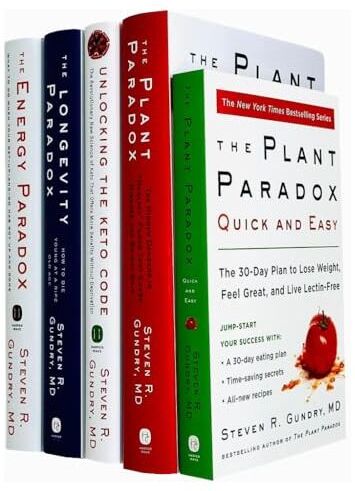
Harper ltd Dr Steven R Gundry 5 Books Collection Set – Plant Paradox, Diet & Gut Health Nutrition CollectionDr. Steven R Gundry MD 5 Books Collection Set (The Plant Paradox, The Longevity Paradox, The Energy Paradox, Unlocking The Keto Code & [Paperback] The Plant Paradox Quick and Easy): The Plant Paradox Quick and Easy[Paperback]: The Plant Paradox, readers learned the surprising truth about foods that have long been regarded as healthy. Lectins—a type of protein found in fruits, vegetables, legumes, dairy, and grains—wreak havoc on the gut, creating systemic inflammation and laying the groundwork for disease and weight gain. The Plant Paradox: In The Plant Paradox, renowned cardiologist Dr. Steven Gundry reveals that gluten is just one variety of a common, and highly toxic, plant-based protein called lectin. Lectins are found not only in grains like wheat but also in the “gluten-free” foods. The Longevity Paradox: Dr. Gundry has discovered that the “diseases of aging” we most fear are not simply a function of age; rather, they are a byproduct of the way we have lived over the decades. In The Longevity Paradox, he maps out a new approach to aging well—one that is based on supporting the health of the “oldest” parts of us: the microorganisms that live within our bodies. The Energy Paradox: Dr. Gundry expands upon his previous discussions of gut, microbiome, and mitochondrial health, linking immune malfunction to the mental and physical symptoms of fatigue—including exhaustion, brain fog, depression, anxiety, and low metabolism. Unlocking the Keto Code: In Unlocking the Keto Code, Dr. Gundry reveals the biological mechanism that makes keto diets so successful: a cellular process known as “mitochondrial uncoupling.” As it turns out, ketones are not the magical fuel source they’ve been made out to be.22,45 £*Shipping: 2,99 £Secure redirect to the provider
-
Organic Castor Oil Pack Wraps, Natural Liver Detox & Abdominal Wellness Solution Organic Castor Oil Pack Wraps, Natural Liver Detox & Abdominal Wellness SolutionCastor Oil Pack Wraps are disposable, selfadhesive patches designed to naturally support liver detox, abdominal wellness, and digestive comfort. They provide a simple, safe, and messfree way to help your body eliminate toxins, improve circulation,...40,97 $*Shipping: 0,00 $Secure redirect to the provider



-
How do you calculate the braking deceleration?
To calculate the braking deceleration, you need to know the initial velocity of the object, the final velocity (usually 0 if the object comes to a stop), and the time it takes for the object to come to a stop. The formula to calculate deceleration is: deceleration = (final velocity - initial velocity) / time. By plugging in the values for final velocity, initial velocity, and time into this formula, you can calculate the braking deceleration of the object. **
-
How does uniform deceleration work in physics?
Uniform deceleration in physics refers to a constant decrease in velocity over time. This means that the object is slowing down at a consistent rate. The rate of deceleration is measured in terms of acceleration, with a negative sign to indicate that it is in the opposite direction of the initial velocity. This can be represented by the equation a = (vf - vi) / t, where a is the acceleration, vf is the final velocity, vi is the initial velocity, and t is the time taken. Uniform deceleration is important in understanding the motion of objects and can be used to calculate stopping distances and braking forces in real-world scenarios. **
-
Friction on an inclined plane causes deceleration.
Friction on an inclined plane causes deceleration because it acts in the opposite direction of the object's motion. As the object moves up or down the incline, the friction force opposes its movement, reducing its speed. This deceleration is due to the friction force converting the object's kinetic energy into heat. The steeper the incline or the greater the coefficient of friction, the stronger the deceleration will be. **
-
What is the deceleration of the brakes 2?
The deceleration of brakes 2 is 5 m/s^2. This means that the brakes are slowing down the car at a rate of 5 meters per second squared. A higher deceleration value indicates a stronger braking force, which can help the car come to a stop more quickly. It is important for drivers to be aware of the deceleration of their brakes to ensure safe and efficient stopping. **


What is the formula for deceleration in physics?
The formula for deceleration in physics is given by the equation: a = (v - u) / t, where a is the deceleration, v is the final velocity, u is the initial velocity, and t is the time taken. This formula calculates the rate at which an object slows down, or decelerates, over a certain period of time. Deceleration is a negative acceleration, so the value obtained from the formula will be negative, indicating a decrease in velocity. **
How do you calculate the braking deceleration 2?
To calculate the braking deceleration 2, you can use the formula: a = (v_f - v_i) / t, where a is the deceleration, v_f is the final velocity, v_i is the initial velocity, and t is the time taken to decelerate. First, determine the initial and final velocities of the object. Then, measure the time it takes for the object to come to a complete stop. Finally, plug these values into the formula to calculate the braking deceleration 2. **
Top-Angebote
Products related to Deceleration:
-
Nourish Books Rose Elliot Complete Vegan Cookbook – Plant-Based Diet Recipes & Health Benefits Guide Healthy Vegan Cooking & Nutrition BookRose Elliot's Complete Vegan Description The ultimate bible of plant-based eating; by renowned vegan cook Rose Elliot. With an increasing awareness of the ethical; environmental and health benefits of following a plant-based diet; the vegan movement is now stronger than ever. Rose Elliot has been at the forefront of meat-free foodwriting for over 35 years; and here offers readers a masterclass in vegan cookery. The book includes more than 150 recipes; from basics such as nut milks; butters; cheeses and creams; to recipes for breakfasts; light bites and lunches; labour-light midweek mains; spectacular dishes for entertaining; delicious desserts and tempting baked goods. The recipes range from comforting dishes like Macaroni Cheese to more exotic fare; such as a fragrant Aubergine Pilaff Cake. Proving that following a vegan diet doesn't mean missing out on your favourite foods; the book also shows how to whip up a creamy mayo; classic Yorkshire pudding or wonderfully crisp meringue at home; all without using any animal products. Packed with beautiful photography; and mouthwatering recipes; Rose Elliot's Complete Vegan is the ultimate resource for any vegan cook no matter their level of experience or expertise.5,88 £*Shipping: 2,99 £Secure redirect to the provider
-
Evolve Beauty Evolve Organic Beauty Superfood Shine Conditioner 250mlRevitalise your hair care routine with the Evolve Organic Beauty Superfood Shine Conditioner 250ml. Specially formulated for normal to dry hair, this luxurious conditioner harnesses the power of natural and organic ingredients to replenish brilliant shine, significantly reduce frizz, and boost irresistible softness. Its lightweight yet deeply nourishing formula ensures your locks remain healthy, smooth, and entirely tangle-free.At the heart of this high-performance conditioner are natural baobab proteins, which have been scientifically shown to strengthen and protect hair while boosting overall smoothness. Complemented by organic pomegranate extract, it works to intensely rehydrate and defend your hair against environmental stressors. Additionally, organic aloe vera gently soothes the scalp, providing a calming and refreshing experience with every wash.Perfect for anyone seeking clean, conscious beauty that delivers professional results, this superfood-infused conditioner leaves hair feeling revitalised, manageable, and radiantly glossy. Elevate your daily routine and unlock the secret to naturally beautiful, frizz-free hair with this essential organic treatment.Key BenefitsReplenishes shine, reduces frizz, and boosts softness for smooth, tangle-free, and healthy hair - Strengthens and protects hair while boosting smoothness using nutrient-rich baobab proteins - Rehydrates the hair and soothes the scalp with organic pomegranate extract and aloe veraIngredients:Aqua (Water), Cetearyl Alcohol, Coco-Caprylate, Distearoylethyl Dimonium Chloride, Gluconolactone, Parfum (Naturally Derived Fragrance), Hydrolyzed Adansonia Digitata (Baobab) Seed Extract, Punica Granatum (Pomegranate) Fruit Extract*, Aloe Barbadensis Leaf Juice Powder*, Helianthus Annuus (Sunflower) Seed Oil, Glycerin**, Polyglyceryl-6 Stearate, Sodium Benzoate, Polyglyceryl-6 Behenate, Tocopherol, Calcium Gluconate, Benzyl Alcohol, Potassium Sorbate, Citric Acid, Citral, Geraniol, Limonene, Linalool16,00 £*Shipping: 2,95 £Secure redirect to the provider
-
Harper ltd Max Lugavere 2 Book Set – Genius Foods & The Genius Life Brain Health, Nutrition & Wellness CollectionMax Lugavere 2-Book Collection Set (The Genius Life & Genius Foods – Nutrition, Health, Wellness, Diet, Brain & Body Health, Self-Help & Fitness) The Genius Life: Heal Your Mind, Strengthen Your Body, and Become Extraordinary: Supporting the work of Battersea Dogs and Cats Home.Enjoy a heartwarming dog to brighten every single day of the year. From Pickles, the dog who single-handedly saved the 1966 world cup, to Pal, who found silver screen fame as the original Lassie, Battersea's A Dog a Day contains 365 fascinating stories of dogs to enjoy throughout the year.Beautifully packaged and illustrated throughout with charming illustrations of cheeky puppies and hounds, this is the perfect book for any lover of our four-legged friends. Genius Foods: Become Smarter, Happier, and More Productive While Protecting Your Brain for Life: After his mother was diagnosed with a mysterious form of dementia, Max Lugavere put his successful media career on hold to learn everything he could about brain health and performance. For the better half of a decade, he consumed the most up-to-date scientific research, talked to dozens of leading scientists and clinicians around the world, and visited the country’s best neurology departments—all in the hopes of understanding his mother’s condition.Now, in Genius Foods, Lugavere presents a comprehensive guide to brain optimization. He uncovers the stunning link between our dietary and lifestyle choices and our brain functions, revealing how the foods you eat directly affect your ability to focus, learn, remember, create, analyze new ideas, and maintain a balanced mood.12,95 £*Shipping: 2,99 £Secure redirect to the provider
-
What is the braking deceleration?
Braking deceleration refers to the rate at which a vehicle slows down when the brakes are applied. It is measured in meters per second squared (m/s^2) and represents the negative acceleration experienced by the vehicle as it comes to a stop. The braking deceleration depends on factors such as the vehicle's mass, the friction between the tires and the road, and the force applied to the brakes. A higher braking deceleration means the vehicle will come to a stop more quickly. **
-
How do I calculate the deceleration?
To calculate deceleration, you need to determine the change in velocity and the time it takes for that change to occur. Deceleration is calculated by dividing the change in velocity by the time taken for the change to happen. The formula for deceleration is: deceleration = (final velocity - initial velocity) / time. Make sure to use consistent units for velocity and time in your calculation. **
-
How do you calculate the braking deceleration?
To calculate the braking deceleration, you need to know the initial velocity of the object, the final velocity (usually 0 if the object comes to a stop), and the time it takes for the object to come to a stop. The formula to calculate deceleration is: deceleration = (final velocity - initial velocity) / time. By plugging in the values for final velocity, initial velocity, and time into this formula, you can calculate the braking deceleration of the object. **
-
How does uniform deceleration work in physics?
Uniform deceleration in physics refers to a constant decrease in velocity over time. This means that the object is slowing down at a consistent rate. The rate of deceleration is measured in terms of acceleration, with a negative sign to indicate that it is in the opposite direction of the initial velocity. This can be represented by the equation a = (vf - vi) / t, where a is the acceleration, vf is the final velocity, vi is the initial velocity, and t is the time taken. Uniform deceleration is important in understanding the motion of objects and can be used to calculate stopping distances and braking forces in real-world scenarios. **
Similar search terms for Deceleration
-
Harper ltd Dr Steven R Gundry 5 Books Collection Set – Plant Paradox, Diet & Gut Health Nutrition CollectionDr. Steven R Gundry MD 5 Books Collection Set (The Plant Paradox, The Longevity Paradox, The Energy Paradox, Unlocking The Keto Code & [Paperback] The Plant Paradox Quick and Easy): The Plant Paradox Quick and Easy[Paperback]: The Plant Paradox, readers learned the surprising truth about foods that have long been regarded as healthy. Lectins—a type of protein found in fruits, vegetables, legumes, dairy, and grains—wreak havoc on the gut, creating systemic inflammation and laying the groundwork for disease and weight gain. The Plant Paradox: In The Plant Paradox, renowned cardiologist Dr. Steven Gundry reveals that gluten is just one variety of a common, and highly toxic, plant-based protein called lectin. Lectins are found not only in grains like wheat but also in the “gluten-free” foods. The Longevity Paradox: Dr. Gundry has discovered that the “diseases of aging” we most fear are not simply a function of age; rather, they are a byproduct of the way we have lived over the decades. In The Longevity Paradox, he maps out a new approach to aging well—one that is based on supporting the health of the “oldest” parts of us: the microorganisms that live within our bodies. The Energy Paradox: Dr. Gundry expands upon his previous discussions of gut, microbiome, and mitochondrial health, linking immune malfunction to the mental and physical symptoms of fatigue—including exhaustion, brain fog, depression, anxiety, and low metabolism. Unlocking the Keto Code: In Unlocking the Keto Code, Dr. Gundry reveals the biological mechanism that makes keto diets so successful: a cellular process known as “mitochondrial uncoupling.” As it turns out, ketones are not the magical fuel source they’ve been made out to be.22,45 £*Shipping: 2,99 £Secure redirect to the provider
-
Organic Castor Oil Pack Wraps, Natural Liver Detox & Abdominal Wellness Solution Organic Castor Oil Pack Wraps, Natural Liver Detox & Abdominal Wellness SolutionCastor Oil Pack Wraps are disposable, selfadhesive patches designed to naturally support liver detox, abdominal wellness, and digestive comfort. They provide a simple, safe, and messfree way to help your body eliminate toxins, improve circulation,...40,97 $*Shipping: 0,00 $Secure redirect to the provider
-
Quantum Magnetic Health Analyzer For Full Body Wellness Asd Quantum Magnetic Health Analyzer For Full Body Wellness AsdAdvanced BioEnergy Health Scanning at Home Take charge of your wellness with this quantum magnetic body analyzera handheld device designed to detect subhealth indicators across multiple body systems. Using bioresonance technology and touchbased...189,97 $*Shipping: 0,00 $Secure redirect to the provider
-
Plant Based Cuticle Nutrient Oil yellowRestore the natural vitality of your hands with a highcapacity treatment designed for deep cellular repair. This 75ml cuticle nutrient oil is a professionalgrade solution formulated to nourish and repair damaged nails and surrounding skin. Infused...59,97 $*Shipping: 0,00 $Secure redirect to the provider
-
Friction on an inclined plane causes deceleration.
Friction on an inclined plane causes deceleration because it acts in the opposite direction of the object's motion. As the object moves up or down the incline, the friction force opposes its movement, reducing its speed. This deceleration is due to the friction force converting the object's kinetic energy into heat. The steeper the incline or the greater the coefficient of friction, the stronger the deceleration will be. **
-
What is the deceleration of the brakes 2?
The deceleration of brakes 2 is 5 m/s^2. This means that the brakes are slowing down the car at a rate of 5 meters per second squared. A higher deceleration value indicates a stronger braking force, which can help the car come to a stop more quickly. It is important for drivers to be aware of the deceleration of their brakes to ensure safe and efficient stopping. **
-
What is the formula for deceleration in physics?
The formula for deceleration in physics is given by the equation: a = (v - u) / t, where a is the deceleration, v is the final velocity, u is the initial velocity, and t is the time taken. This formula calculates the rate at which an object slows down, or decelerates, over a certain period of time. Deceleration is a negative acceleration, so the value obtained from the formula will be negative, indicating a decrease in velocity. **
-
How do you calculate the braking deceleration 2?
To calculate the braking deceleration 2, you can use the formula: a = (v_f - v_i) / t, where a is the deceleration, v_f is the final velocity, v_i is the initial velocity, and t is the time taken to decelerate. First, determine the initial and final velocities of the object. Then, measure the time it takes for the object to come to a complete stop. Finally, plug these values into the formula to calculate the braking deceleration 2. **
* All prices are inclusive of VAT and, if applicable, plus shipping costs. The offer information is based on the details provided by the respective shop and is updated through automated processes. Real-time updates do not occur, so deviations can occur in individual cases. ** Note: Parts of this content were created by AI.